Thursday, April 30, 2015

Canyonlands Sunset

Last month we went to Moab, Utah, to spend time in the area - and do some shooting, of course.  One objective I had for the trip was a sunset shoot at Canyonlands National Park.  During a previous trip to the park last October, I spent an evening shooting sunset at the Green River Overlook, but between the lack of clouds in the sky and abundance of people on the ground, the experience came up a little short.  This time I wanted to try a different spot.

During that last trip to Canyonlands I had pulled over at the Candlestick Tower Overlook, which is on the way out to the Grand View Point Overlook in the Island In The Sky section of the park, and spent a few minutes looking around and taking a few shots.  I thought this spot had potential for a sunset shoot and tucked that thought away in the back of my mind. When we headed out this time I had my sights set on two spots - Candlestick Tower Overlook and Holeman Spring Canyon Overlook, which is on the spur road to Upheaval Dome.  After taking a look at both spots that afternoon the decision was made - Candlestick Tower Overlook.

I had decided to use one lens for this shoot - my Nikon 16-85 DX VR.  This would give me a good working range, and I was hesitant to change lenses during the shoot given that there would be a breeze and most likely dusty condition.  After we pulled over in the parking area, I grabbed my camera and tripod and worked my way down to the canyon rim.  Sunset was at 7:39 P.M. that night, and by 6:30 P.M. I was in position.  Now it was just time to hang out and see what would transpire.

Before long a bank of clouds started to move across the sun, casting shafts of light towards the canyon below.  I stayed with a wider angle for this shot, so I could get the canyon walls in the foreground and Soda Springs Basin - to the left of Candlestick Tower - in the shot also. 6:35 P.M.
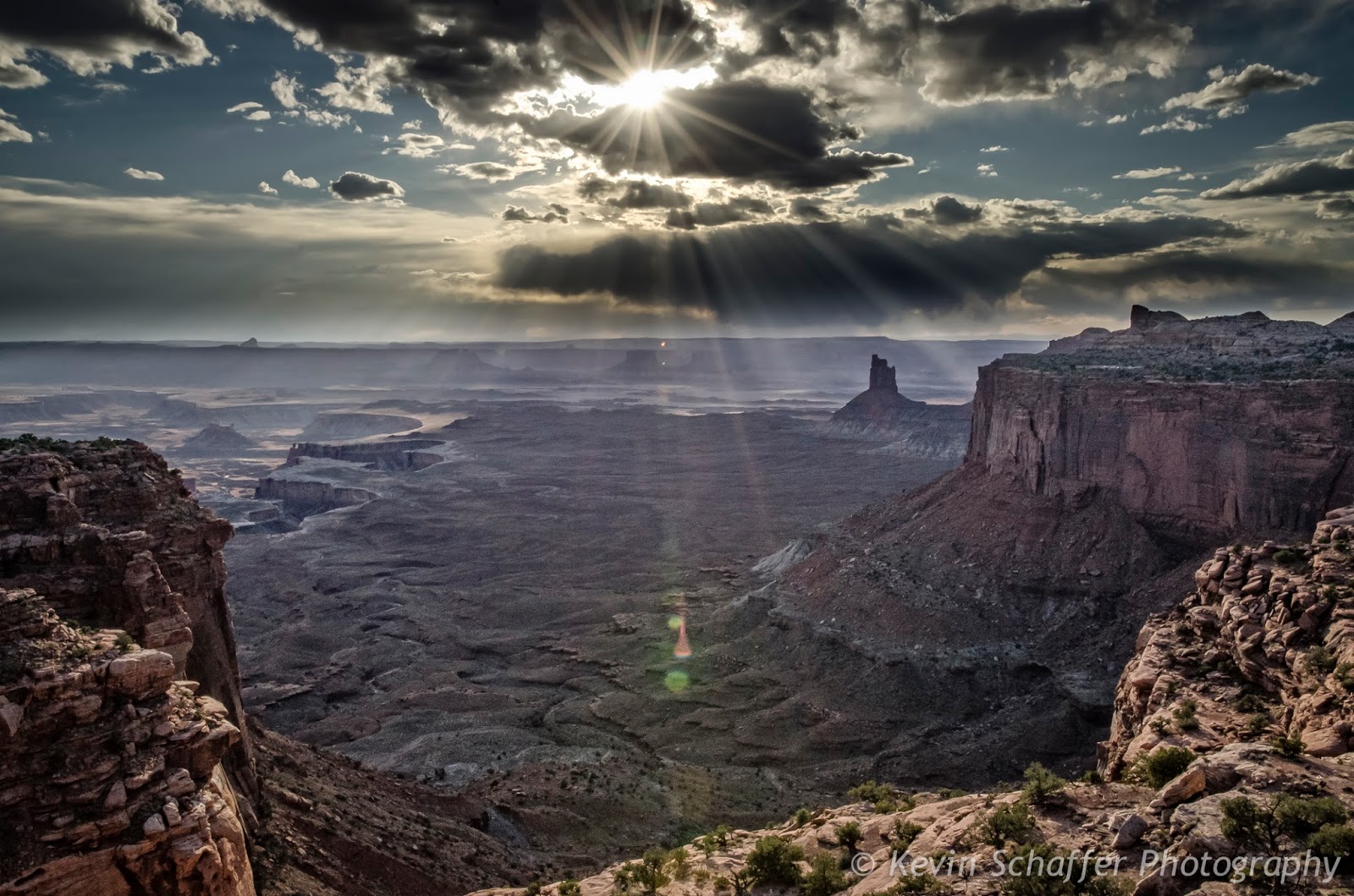
Soon the clouds almost completely covered the sun, and the God rays (crepuscular rays) became the predominant feature of the scene before me.  I zoomed in on Candlestick Tower and tried to emphasize those aspects.  6:37 P.M.

For this shot I zoomed back out a bit to show the golden light on the canyon floor as well as the sun's rays.  Later, when working on the shot in the digital darkroom, I cropped it to a landscape ratio to give the scene a more "sweeping" look.  6:42  P.M.

Then it became a waiting game, taking a few shots now and then, watching the sun slowly descend in the sky.  A few minutes before sunset, as the sun started to touch the horizon, the sky started to glow.  7:30 P.M.

After the sun sank below the horizon the sky turned orange, so I zoomed back in to try and capture that beauty.  7:44 P.M.

This time everything fell into place...

All photos (except camera setup) taken with a Nikon D7000 camera body, and Nikkor 16-85 DX VR lens

You can view my online portfolio and purchase prints here.

Want to keep up to date with where I'll be and what my latest creations are?
Follow me on FaceBook and Google+
I'm also on Twitter @KSchafferPhoto
And now on Instagram: @kschafferphoto


Friday, April 24, 2015

Morning At Broken Arch

About a month ago my wife and I went to Moab, Utah, during her spring break, to check out the two National Parks in the area - Arches and Canyonlands - as well as Dead Horse Point State Park (which I wrote about here) and various other points of interest in the area.  While we were there we took a sunrise hike to Broken Arch in Arches National Park. 

There are arches and destinations in Arches that are more spectacular, or iconic, but a sunrise hike to Broken Arch is probably my favorite.  The trail is easy, about 1.2 miles round trip, following a sandy trail that goes from the parking lot across a large meadow to the arch.  Walking into the sunrise, you can feel the morning sun on your face and watch the shadows forming across the landscape as the sun breaks the horizon.  Dawn that morning was at 6:37, with sunrise at 7:04.  We were on the trail as the sun rose, just in time to watch the subtle differences in light and gesture as Broken Arch met the morning...

I had my wide angle lens (Nikon 10-24 DX) on my camera as we hit the trail, knowing from past experience that I would need a wider angle to frame the arch in its entirety, and that I may be able to incorporate a sunburst in a few shots.  We got to Broken Arch shortly after sunrise, and after I walked around to the east facing side of the arch I took this shot.  7:16 A.M.
 
I then turned towards the arch and scrambled up the rocks to get this shot...  7:18 A.M.

As the sun started to warm the arch I moved closer, framing shots until I found a composition I liked...  7:20 A.M.

I then climbed back down and walked around to the west side of the arch, and started taking tight shots of the arch as the sun began to shine through...  7:31 A.M.

I waited another couple of minutes until the sun hit the rim...  7:33 A.M.
 
Then I switched to my fisheye lens.  This lens lends a little more curvature to the scene, and also produces a "tighter" sunburst, with more defined rays.  This was taken at 7:38 A.M.  
  
Broken Arch is definitely worth the effort of getting out of bed to catch sunrise.  The next time I'm in Moab, I'll be sure to make the trek again...

All photos taken with a Nikon D7000 camera body, and Nikkor 10-24 DX (wide angle) and Nikkor 10.5 DX (Fisheye) lenses

You can view my online portfolio and purchase prints here.

Want to keep up to date with where I'll be and what my latest creations are?
Follow me on FaceBook and Google+
I'm also on Twitter @KSchafferPhoto
And now on Instagram: @kschafferphoto


Tuesday, April 7, 2015

Catching Sunrise at Dead Horse Point

“Your landscape pictures shouldn’t say ‘I was here,’ they need to say ‘you need to be here.’” ~ Moose Peterson

Last week the wife and I spent Spring Break in Moab, Utah, one of my favorite places to explore and photograph, jumping point to Arches National Park, Canyonlands National Park, and several smaller yet also noteworthy areas.  While in Moab one of things I wanted to do was catch sunrise at Dead Horse Point State Park, an area I hadn't visited yet.  The park is known for a dramatic overlook of Canyonlands National Park and a section of the Colorado River known as the Gooseneck.  I knew the time had come to see this in person.

We made the decision to head out to Dead Horse Point on the morning of March 31.  Dawn that morning was 6:40AM, with sunrise at 7:06 AM (I'd like to take a moment and recommend SunCalc - located at www.suncalc.net - a free desktop app that shows sun movement and sunlight phases during any given day at any given location, with the ability to go back in time and look up sunrise/sunset times, which is a handy feature for people like me who don't always take the best notes).  Knowing that the drive to the park from Moab would take about 45 minutes, and that I would want to be into position early to get the best spot to shot that morning, necessitated a 4:15 AM wake-up.  Thankfully my wife is a light sleeper and early riser, so all I had to do was get up - knowing I could leave the driving to her...

We arrived at the destination around 6, and after a brief wait walked out to the overlook, took a look around, picked a spot, hopped over a wall, and got into position on a ledge overlooking the river at around 6:25 AM.  I set up my tripod and mounted a 16-85mm mid-range zoom to my camera, so I would have a good range of focal lengths to work with...   
 
With sunrise coming at 7:06 AM, now it was time to wait and watch the light.  At 6:45 AM. I took a few shots of the cool, dawn, pre-sunrise light.  When post-processing the shot later I used a Tilt Shift effect to give it a both a "miniature" look, and to help pull the viewer in... 

A few minutes later the sun rose, then at 7:17 AM the sun started to hit the top of the ridge on the canyon's far side, opposite the sunrise.  There were few clouds in the sky, but the light playing off the canyon walls was more than enough to get my full attention...

7:20 AM.  As the sun rose higher in the morning sky, the light started working its way down the canyon walls and hit the ridge on the piece of land circumvented by the Gooseneck section of the Colorado River...

7:25 AM...  At this point I switched to my wide angle (10-24mm) lens.  The canyon lands were bathed in light now, with a strong reflection of the landforms in the Colorado River, and I wanted to use a wider angle of view to show as much of the light playing off the land as I could...

7:40 AM.  The sun had risen high enough in the sky by this point that the light was starting to even out a bit, and although it was still a spectacular sight, the best shots of the morning had been taken.  After breaking down my tripod and hopping back over the wall to the foot paths, I still had one more shot I wanted to get.  On the way in I had seen this juniper tree, and I wanted to get a couple of shots with the morning light kissing it.  Still using my wide angle lens, I zoomed all the way out to 10mm and walked up as close to the tree as I could while still capturing the sky behind it.  I was probably two feet from the tree when I took this shot...

Dead Horse Point.  What is there to say other than I want to go back, to catch another sunrise, to catch a sunset, to marvel once again...

All photos taken with a Nikon D7000, and Nikkor 16-85 DX VR and 10-24 DX lenses.  Camera support provided by a Manfrotto 190XPROB Pro Aluminum Tripod with Manfrotto 496RC2 Compact Ball Head.

View my online portfolio here
       

Tuesday, March 24, 2015

Get Appy

“Photography is the power of observation, not the application of technology.” ~ Ken Rockwell 

Or, it can be the power of observation coupled with the application of (new to you) technology.  Looking for ways to expand the reach of my brand and give a "here's what I'm up to right now" look at my work - albeit a little late to the party - I started posting to Twitter (@KSchafferPhoto) last October, and a couple of weeks ago I started an Instagram (@kschafferphoto).  Using my phone to take photos on the road and post them to social media has given me a different eye with which to see the world around me and given me a different set of tools to further enhance that vision.  As I've spent more time using my phone (an iPhone 5) as a creative tool, I've accumulated and experimented with a few photo apps, which I'll discuss before moving on to some examples.

Here's a breakdown of the photo apps I have on my phone, in alphabetical order, and a quick thought about each:

Aviary (free) - I use this app when I want to add text to a photograph - like a watermark - or need a "one click" solution for a landscape photo that isn't too "over the top."  For example, using the Enhance > Scenery filter adds some contrast, exposure, and saturation adjustments to a photo that I can then quickly post.
Camera+ (free) - I've had this app for a couple of months and use it when I want a "one click" solution that gives a "faux HDR" look.  Using the "Clarity" filter gives me that quick solution that produces a photo with saturated colors and some "pop."
Priime (free) - This is the newest of the apps, only released last week.  I haven't done much with it yet, but here's an article that discusses it in some detail.
Snapseed (free) - This is the app I use when I have time to experiment with making several adjustments.  Starting with the Drama or HDR Scape filters then making finer adjustments is usually the route I take with this app.
SlowShutter ($.99) - This is another recent addition.  I've taken a few shots with it to get a feel for how it works, but don't have an example that's worth sharing at this time.  As the name of the app implies, it allows you to use slower shutter speeds with your phone's camera.
VSCOcam (free) - Another recent addition that I'm only beginning to explore.  VSCO produces plugins for programs like Photoshop that emulate the look of film, and this app does the same thing, with the ability to further edit the photo once taken.  One of the photographers I respect the most, David duChemin, uses this app (and SlowShutter) extensively and creates some beautiful work, and I'm looking forward to carving out the time to get more familiar with it.
vividHDR ($1.99) - I've only had this app for a couple of weeks, but it's quickly become my favorite.  One click, pick a style, and then do some editing in the app and you're ready to post.  This is already my go to app for black and white photography. 

This past week I took a short road trip to Amarillo, Texas, to see what there was to be seen.  The first stop I made was Cadillac Ranch, just outside of Amarillo, a piece of Americana that I've wanted to see for quite some time.  I don't know why, but I have a fascination with the quirky roadside attractions that dot the landscape of the America.  This photo was taken using the Camera+ app, then applying the "Clarity" filter.

Next stop was Palo Duro Canyon State Park, about 30 miles from Amarillo.  It was an overcast day, the sun peeking out occasionally, as I drove through the park.  This shot was taken using the Snapseed app, then applying the HDR Scape filter before doing some final in app editing.
 
Further in Palo Duro Canyon State Park I saw this gorgeous scene, pulled my car over, and walked up the hill a bit to get a better vantage point.  This shot was taken with the vividHDR app.  I then applied the Dramatic filter and made a few adjustments. 

The next morning I woke to an overcast, foggy day, and I headed back to the canyon hoping that the skies would clear up as the day wore on.  This didn't happen, so after exploring the park a bit I headed back out and drove around exploring the Texas Panhandle.  At one point I saw this lone tree with the two toned background and spent quite a bit of time photographing it, both with my phone and my DSLR.  This shot was taken using the vividHDR app, applying the Lively filter, then making a couple of quick adjustments.

On the third day I headed back to Santa Fe, but not before stopping at Cadillac Ranch early in the morning.  Again, I spent quite a bit of time photographing the scene with both my phone and camera.  This shot was taken with Snapseed, and then applying the HDR Scape filter and making a few adjustments.

On the way back home to Santa Fe, I made a point of stopping by the (near) ghost town of Cuervo, New Mexico.  This shot was taken with vividHDR, then applying the Gray Art filter before making some minor adjustments.
  
Using my phone as a vehicle for capturing scenes and doing some mobile editing has given me a new way of approaching photography and looking at the world - and given me a chance to share that in real time...  

View my online portfolio here
Follow me on Twitter: @KSchafferPhoto
Follow me on Instagram: @kschafferphoto


Saturday, March 7, 2015

Rio Grande Arts & Crafts Festival Spring Show

I will be showing a selection of my work at the Rio Grande Arts & Crafts Festival's 27th Annual Spring Show in Albuquerque, New Mexico, March 13-15.  The show will be held in the Lujan Exhibit Complex at the Expo NM Fairgrounds.  This is an indoor show, so I'll be there rain or shine!  You can find more details about the show here.

I will be premiering several new pieces at this show and will have a few items available - matted prints and greeting cards - for the first time.   

"Dune At Dusk" will be available in two formats: a 20" x 30" stretched giclée canvas print mounted on a wood frame, ready to hang, for $150, or my latest offering, a 10.8" x 14.4" glass print (the image is printed directly onto a glass plate), ready to hang, for $125.

"Tumacácori" will be available as a 12" x 16" stretched giclée canvas print mounted on a wood frame, ready to hang, for $65.

"Memories In Sepia" will be available as a 14" x 14" stretched giclée canvas print mounted on a wood frame, ready to hang, for $65.

"Twisted Into Form" will be available as an 16" x 16" Infused Aluminum Print, ready to hang, for $125.

I will also have 8" x 12" prints matted to fit a "16 x 20" frame.  These photos are printed on Kodak Endura or Fuijifilm Crystal Archive paper, mounted in a high-quality, acid-free matte and housed in a protective clear plastic sleeve, so you can safely store your print until you find the perfect frame.  These matted prints will be $35 each, or 3 for $90. 

Finally, I will have available for purchase 5" x 7" greeting cards (with envelope).  Each card depicts a scene from southwest, like the example below, the San Ysidro Catholic Church in the Village of San Ysidro, New Mexico.  These cards will be $3.50 each, or 3 for $10.

I'm looking forward to this, my first show, and hope to see you there!

You can view my online gallery and order prints here

Want to keep up to date with where I'll be and what my latest creations are?
Follow me on FaceBook and Google+
I'm also on Twitter @KSchafferPhoto

Friday, February 27, 2015

Am I There Yet?

Last November I went back to Kansas, the place of my birth, where I spent the first the first ten years of my life - and where my parents and sister live - for a quick visit and to help out with a "special project."  It was literally a quick trip - I drove the 718 miles to Kansas non-stop the first day - but I brought some of my camera gear along just in case I saw something that I absolutely had to stop for.

If you've ever been through Kansas (or Oklahoma, or Texas, or any other wide open stretch of road on the Great Plains) you know that there's a certain monotony to the drive, broken up by small towns and the occasional roadside attraction from a bygone era.  But, there's also a beauty to much of it, small towns and farms and old pickup trucks that harken back to a simpler time.  This post is about finding that beauty.

On November 16 I had to drive east from Newton to Ottawa, mostly along Highway 50, then west from Ottawa to Marion, then southwest back to Newton where I had decided to stay while I was there.  I left the hotel at about 6:30 AM that morning and plunged into a nasty snow storm.  It was slow going at first, but after about 45 minutes I cleared the path of the storm and was left with a cold, grey, overcast sky.  I had intentionally left a little early, leaving time to stop and take photos if something caught my eye.

7:36 AM.  About 35 miles east of Newton on Highway 50, I spotted this old schoolhouse, and I drove up the gravel road a short distance to grab a few shots.  The front of the schoolhouse had an inscription stating that it was built in 1986 for District 34... 

7:54 AM.  I pulled over and spent a few minutes photographing this abandoned trading post along Highway 50 on the outskirts of Elmdale (population 55)...

8:04 AM.  Outside of Strong City I saw this tree, and it's white trunk really stood out against the grey sky.  I did a quick U-turn and pulled over...


8:14 AM.  As I was driving through Strong City (population 485) I decided to turn down what appeared to be the main drag - it was the street with the church on it - and after driving a couple of blocks I spotted this old Dodge Ram truck...

8:15 AM.  Another shot of the Ram, which was a great subject...

While driving to Ottawa, I had seen a small sign for the Stone Arch Bridge in Clements.  Glancing over, I couldn't see anything as I went by, but I made a mental note of it.  After taking care of what needed to be taken care of in Ottawa, I headed back towards Marion, the next stop that day...  

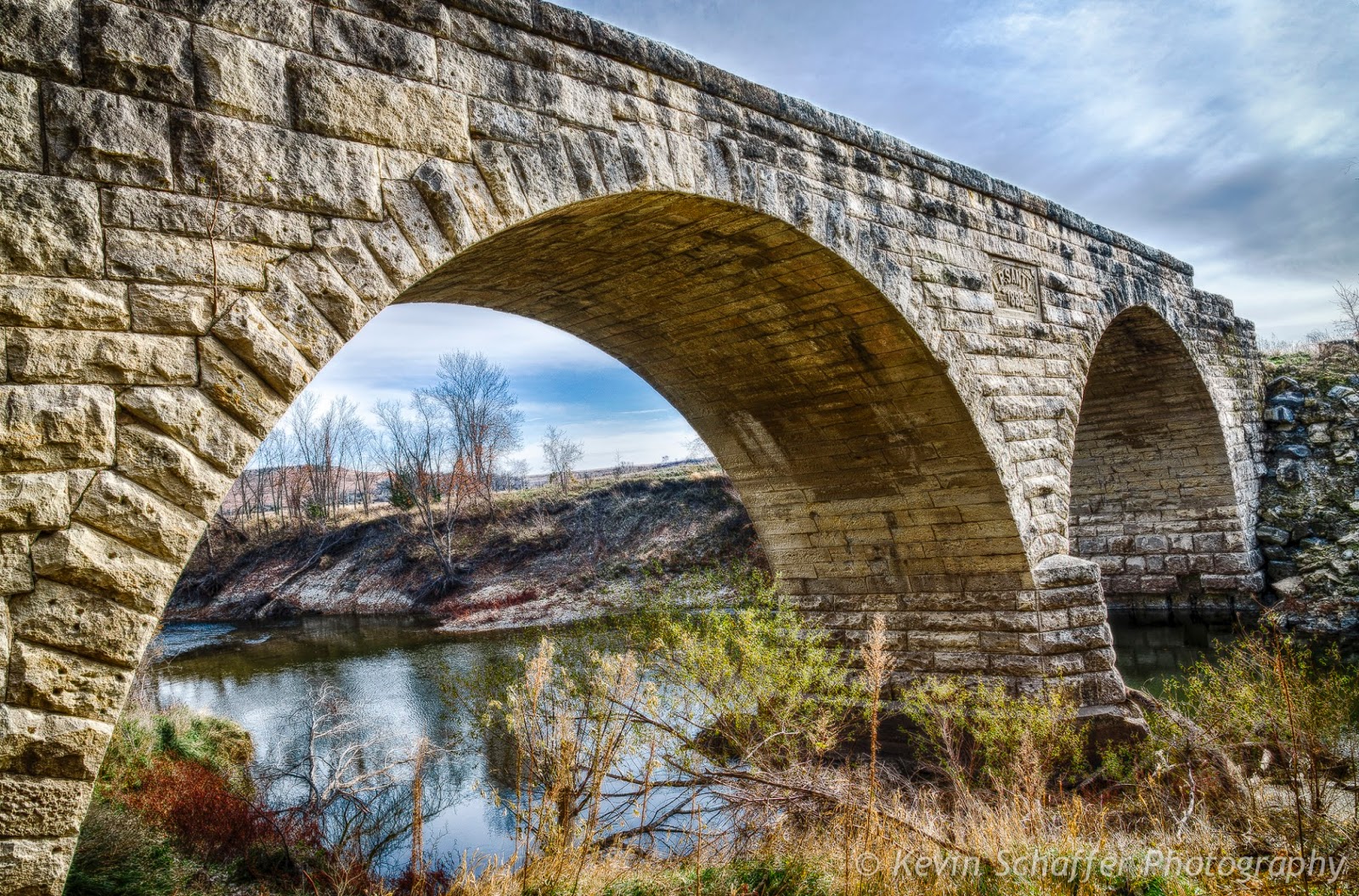
2:32 PM.  On the drive to Marion I kept my eye out for the Stone Arch Bridge, and soon was driving on a small gravel road that went through what once was the town of Clements.  Constructed in 1887 from native limestone, the Stone Arch Bridge is now closed, but accessible to the curious... 

2:34 PM.  I took this shot looking west over the bridge as the sun tried to burn through the cloud cover...

2:38 PM.  Heading back to the highway I saw this old store (house?), and what caught my eye was the decorative tin panels nailed to the front and how they reflected the afternoon light...

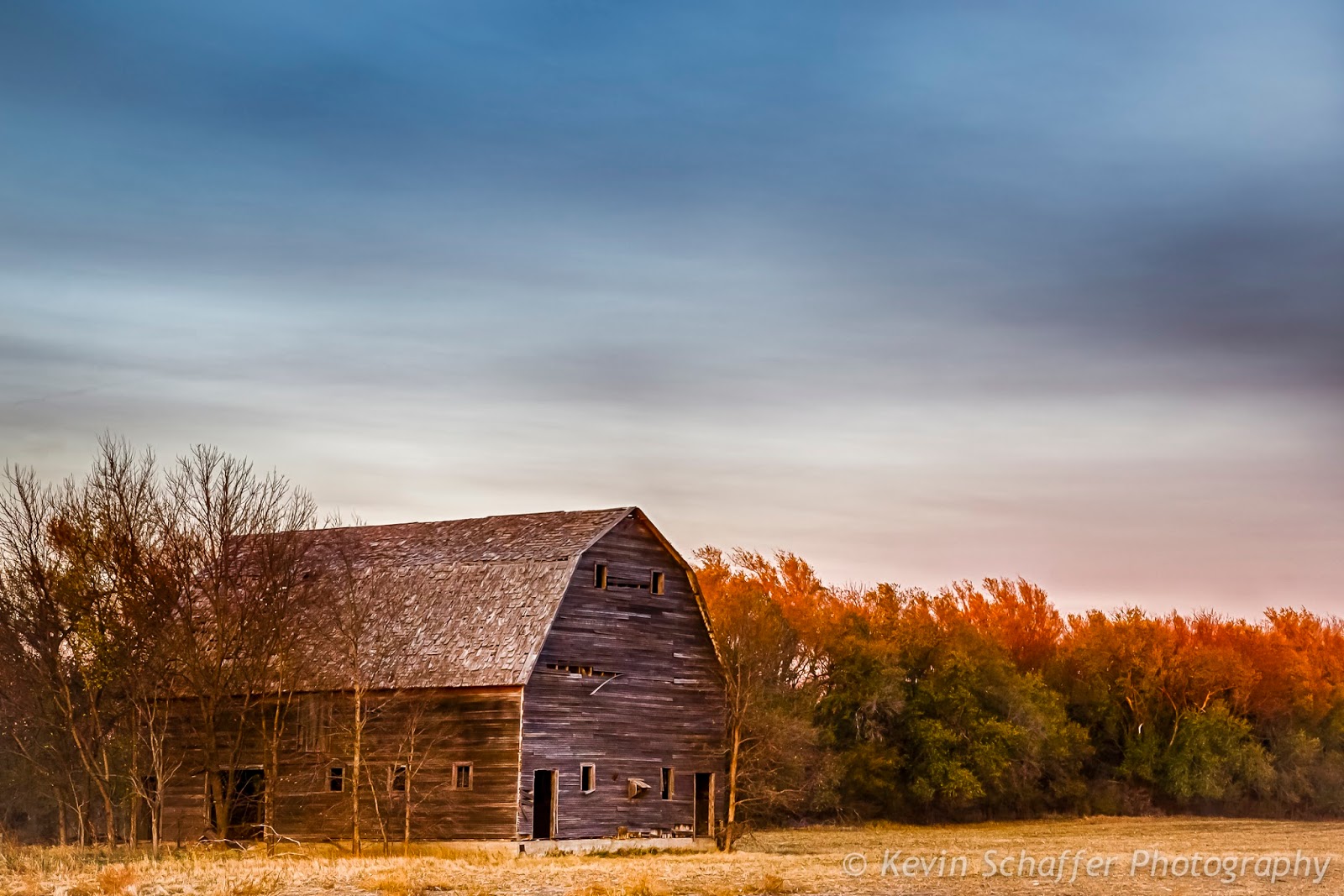
5:10 PM.  As the sun faded I left Marion and headed back towards Newton, driving down Old Highway 77 which eventually turns into Sunflower Road, then intersects with Highway 50.  Not far outside of Marion I saw this old barn, bathed in the light from the setting sun...     

5:23 PM.  Near the intersection with Highway 50 the sky caught fire over the field of hay bales...  

And the next morning I was headed back home to Santa Fe.  A quick trip, and I passed up a lot of photo opportunities because I had to be somewhere by a certain time, but I still managed to get a little photo work on the way.  Next time I go home to visit I'll be sure to go at a slower pace, so I stop and explore and soak in the beauty of the Great Plains...

All photos taken with a Nikon D7000 camera body and Nikkor 16-85 DX VR lens

View my online portfolio here
Follow me on Facebook and Google+
I'm also on Twitter - @KSchafferPhoto         

Saturday, February 21, 2015

White Sands National Monument

Last weekend we went to White Sands National Monument in southern New Mexico for the first time.  White Sands is an endless landscape of line, form, abstraction, sweeping curves, shadows, and light playing off the sand.  Everywhere I turned something caught my eye, and the challenge wasn't finding something to photograph, but trying to find something to photograph that didn't have footprints in it.  

Home to the largest gypsum dune field in the world, White Sands has a unique look unlike anything I've seen.  Since gypsum is naturally water-soluble, it can compact and become more solid than other types of sand (Wikipedia), so unlike sand dunes on an ocean beach I found it easy to walk up and the dunes at White Sands.  We arrived about an hour before the monument closed for the day and soon set out across the dunes exploring.

It didn't take long for the late afternoon light playing off the ripples in the sand to catch my eye...

A little later, after climbing up to the top of a dune, I looked in the opposite direction of the setting sun and saw an expanse of white sand and clear, cloudless blue sky...

Looking in the other direction was the dune blanketed in ripples of sand in the foreground and the dune behind it, cloaked in shadow, a study in contrast...

Then the sun faded further on the horizon, plunging the east side of the landforms into shadow...

Dunes crisscrossing one another, intersections of light and shadow...

Long shadows as the days fades away...

The next morning we went back to catch the sunrise, a cool, clear, quiet morning, perfect for meandering around the dunes...

When processing the photos later, the insistence of line, form, and shadow in catching the eye informed the decisions made in the digital darkroom, leading to experimentation in tone to try and invoke the feeling I got when in that moment...

All photos taken with a Nikon D7000 camera body, and a Nikkor 16-85 DX VR lens

View my online portfolio here