A couple of weeks ago we went on a day trip to Fort Union National Monument, located about 95 miles by road northeast of Santa Fe. Fort Union is located near the intersection of the Mountain and Cimarron Branches of the Santa Fe Trail and was the largest 19th century military fort in the region (U.S. National Park Service).
There were three separate forts at the site, constructed during the forty years the United State Army used it as an outpost. The majority of the site consists of the second of the three forts, with ruins of the third still visible.
There is a path that runs in a roughly circular pattern around the site, which is typically walked in a clockwise direction. One of the first things you come across are the remnants of officer's quarters. Most of the walls are gone, but there remains numerous chimneys in varying states of decay.
Further along the trail are the ruins of the storehouses, the walls of which are largely intact. The windows of the storehouses were perfectly aligned - it was this looking through the window, through the window, through the window, perspective that caught my eye.
Next to the storehouses was the mechanics corral. This area held several wagons, and since wagons have become one of my favorite "old west" things to photograph, I spent some time trying different compositions and perspectives.
On the way out of the mechanics corral, looking back, I stopped to grab a few wider shots of the area...
Fort Union was integral in protecting commerce on the Santa Fe Trail, staging ground for Union troops protecting the territory from the Confederacy during the Civil War, and defender of the southwest during the mid to late 1800s. I wouldn't consider it a "destination" locale, but definitely worth working into your itinerary if you're in the area...
Nikon D7000, Nikkor 10-24 DX
You can purchase prints of my New Mexico (and other) photos here
Random thoughts from someone on a journey that started off on a whim and ended up becoming a passion...
Monday, February 24, 2014
Monday, February 17, 2014
Interiors
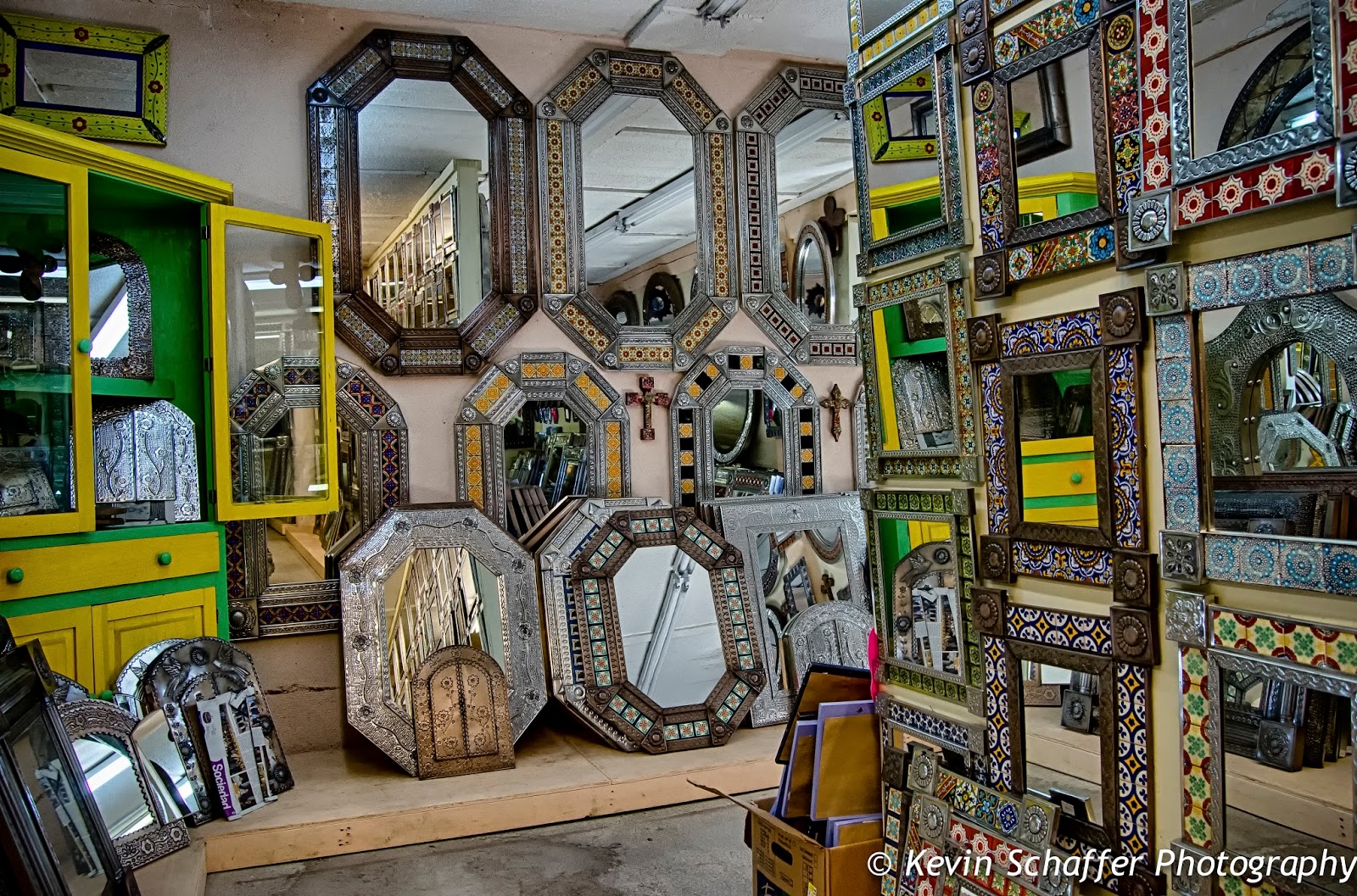
Lately I've tried to bring my camera along whenever I head out the door, trying to bring it into roadside tourist traps, antique stores, wherever, in case something catches my eye. I've found that these places hold numerous opportunities for interesting photographs - the low light, light pouring through windows, filtered through layers of dust and aged glass, angled light creating shadows, bouncing off the walls and mirrors, falling on a variety of brightly colored kitsch, antiques with textured features, aged wood, clutter and dust...
An antique store in Las Vegas, where the light coming in from a dirty window caught my eye...
Casa Grande Trading Post and Petting Zoo in Los Cerrillos, with the glowing bottles and dirty window...
A roadside tourist trap in Taos, with its corner of mirrors capturing, bouncing, repeating reflections...
A store in Santa Fe, with the beam of light coming through the window, illuminating the brightly colored blankets...
And another photo from a later stop at the Casa Grande Trading Post and Petting Zoo in Los Cerrillos, where the cacophony of antiques, aged wood, and shadows are both intriguing and overwhelming at the same time...
Nikon D7000, lens (top to bottom) Nikkor 18-55 DX, Nikkor 10-24 DX, Nikkor 18-55 DX, Nikkor 18-55 DX, Nikkor 18-55 DX
Prints, and merchandise featuring my photos, can be purchased here
An antique store in Las Vegas, where the light coming in from a dirty window caught my eye...
Casa Grande Trading Post and Petting Zoo in Los Cerrillos, with the glowing bottles and dirty window...
A roadside tourist trap in Taos, with its corner of mirrors capturing, bouncing, repeating reflections...
A store in Santa Fe, with the beam of light coming through the window, illuminating the brightly colored blankets...
And another photo from a later stop at the Casa Grande Trading Post and Petting Zoo in Los Cerrillos, where the cacophony of antiques, aged wood, and shadows are both intriguing and overwhelming at the same time...
Nikon D7000, lens (top to bottom) Nikkor 18-55 DX, Nikkor 10-24 DX, Nikkor 18-55 DX, Nikkor 18-55 DX, Nikkor 18-55 DX
Prints, and merchandise featuring my photos, can be purchased here
Monday, February 10, 2014
Abiquiu
Last February was the first time I really visited New Mexico (I drove through New Mexico in the fall of 1986, but I don’t remember any details, since we were on the Interstate and just trying to make good time on the way to our final destination). It was a short visit, staying in Santa Fe for a couple of days, but it was long enough for Santa Fe quickly to end up on the short list of “places we want to move to when we leave Alaska.” Ultimately, Santa Fe rose to the top of the list, and we moved here in the end of last June…
Just before the town of Abiquiu is the turn off to Plaza Blanca (“the White Place”). This is an area Georgia O’Keefe painted on numerous occasions…
Dar al Islam, an Islamic education center, is located near Plaza Blanca; in fact, Plaza Blanca is located on land owned by the center, who graciously allow people access to the area, free of charge. They also allow you to stroll the grounds of the center, and once I took the time to do just that. I found myself fascinated by the doors and windows of the main building (a reoccurring theme since I moved to Santa Fe).
Up the road is Abiquiu Lake, a reservoir formed by damning the Rio Chama River. Usually the lake is just something I drive by and glance at on the way to Ghost Ranch, but on this particular day the reflection of the nearby mountains in the water was so striking that I had to pull over and take a few shots...
Ghost Ranch is where Georgia O'Keeffe eventually settled in 1940. She said of Ghost Ranch and Northern New Mexico: "Such a beautiful, untouched lonely feeling place, such a fine part of what I call the 'Faraway'. It is a place I have painted before . . . even now I must do it again" (Wikipedia). This is a shot taken near Ghost Ranch, which lies on the other side of this ridge...
About four miles up the road from Ghost Ranch is Echo Amphitheater, a small park with a short trail that leads to a spectacular natural amphitheater...
Much like Georgia O'Keeffe I find myself drawn to this area, for I am always drawn in by its natural beauty...
Nikon D7000, lens (from top to bottom) Nikkor 10-24 DX, Nikkor 18-55 DX, Nikkor18-55 DX, Nikkor 18-55 DX, Nikkor 10.5 Fisheye
Purchase prints and other merchandise featuring my photos of New Mexico here
Monday, February 3, 2014
Bandelier National Monument
This past weekend we finally made it to Bandelier National Monument. Located about 44 miles by road from Santa Fe, the main attractions are the ancestral dwellings and other things of archaeological significance left behind by the Puebloan people, that are located in Frijoles Canyon.
We started by walking along the Main Loop Trail, which runs along the right hand side of the canyon as you leave the visitors' center. After a short distance you can climb some short sets of stairs and then some small ladders to check out some cavates, alcoves carved by the Puebloan peoples in the soft volcanic rock (Wikipedia).
One of these is large enough that, once inside, you can stand comfortably and look around. Of note was the ceiling, still blackened by ancient campfires.
After crossing the creek that runs through the canyon, we headed up the Alcove House Trail, which goes up the canyon another half mile.
At the end of the Alcove House Trail you can make the 140 foot climb to the Alcove House, via four wooden ladders and some stairs. From the alcove there is a spectacular view of the canyon, and it's not hard to imagine that it would be difficult, if not impossible, for anyone to sneak up on the people who were living there.
The roundtrip from the visitor's center to the Alcove House and back is about 2.25 miles, and - with frequent stops to look around and take photos - took around 2.5 hours. Definitely worth the time (and effort to get up the stairs to the Alcove House), time I would definitely spend again...
Nikon D7000, Nikkor 18-55 DX
Buy prints or merchandise featuring my photos of New Mexico here
Monday, January 27, 2014
El Santuario de Chimayo
The small town of Chimayo, New Mexico, is located about thirty miles by road north of Santa Fe, just off off the High Road to Taos. In Chimayo is El Santuario de Chimayo, a Roman Catholic Church built in 1816. Declared a National Historic Landmark in 1970, the Santuario is widely considered to be "the most important Catholic pilgrimage center in the United States" (Wikipedia).
When visiting the Santuario, the most convenient place to park is around the back. As you enter (or leave) you walk through a courtyard. Along the back side of the courtyard, along a small creek, you'll pass these crosses...
The church is small (60 feet by 24 feet, with 3 feet thick walls). You can get to the church itself by entering through a walled courtyard on either side, or through the front gate...
As you exit the front gate you can walk up a small hill to a short street lined with a few shops and art galleries. Here's another shot of the church, taken as I paused while walking up that hill...
Walking along the small road that runs behind the Santuario, I stopped several times to take pictures. The first time was at a small store. While my wife went inside to check things out, I looked around and took a few photos of the outside of the building...
A bit further down the same road I saw this doorway. There was so much that caught my eye - the arched doorway with the wagon wheel embedded in it, the old swinging doors, the broken but not discarded ladder leaning against the entry, the Coca-Cola sign... Later that evening, when looking through the day's photos, I thought this would be a good candidate for a black and white conversion...
Walking along the small road that runs behind the Santuario, I stopped several times to take pictures. The first time was at a small store. While my wife went inside to check things out, I looked around and took a few photos of the outside of the building...
A bit further down the same road I saw this doorway. There was so much that caught my eye - the arched doorway with the wagon wheel embedded in it, the old swinging doors, the broken but not discarded ladder leaning against the entry, the Coca-Cola sign... Later that evening, when looking through the day's photos, I thought this would be a good candidate for a black and white conversion...
El Santuario de Chimayo, and the surrounding area, is rich with culture and history, and if you're visiting Santa Fe, Taos, or points in between, stopping by the Santuario is worth the small detour.
The first two photos were taken in July 2013, the last three several days ago (January 2014). All photos were taken with a Nikon D7000 outfitted with a Nikkor 18-55 DX lens.
Purchase prints and other merchandise from here
Monday, January 20, 2014
Three Septembers at Eklutna Lake
When I lived in Alaska once of my favorite places to go for a relaxing walk or a hike, especially in the fall, was Eklutna Lake. Located about forty miles driving distance from Anchorage, Eklutna Lake has a well developed trail system that can accommodate anything from easy walks along the shoreline to difficult hikes into the mountains. I usually brought my camera along, and recently I was looking through photos that I had taken there, and decided to reprocess a few of them. I'd like to share a couple of those reworked photos, with a few thoughts...
The first three photos were taken in September 2008, a few months after I'd bought my first DSLR (a Nikon D40). I was still learning how to use that camera, mostly pointing and clicking and flailing away at the point... I took these photos while walking on the multi-use road (four wheelers, bikes, walking) that winds along the left side of the lake. This first one was taken heading out from the parking lot...
The next photo was taken somewhere along the road (I don't recall exactly where). I do remember thinking that the "window" in the trees where I was standing, as I looked at the trees on the side of mountains in distance, made a good frame for a photo...
While walking back to the parking, I was able to zoom in on a distant mountain, and capture the first dusting of snow in the upper elevations. Two seasons caught in one photograph, the coming of winter and the fading of autumn...
In September 2010 we had an unusually warm spell, so I took advantage of that on a Saturday and hiked the Twin Peaks trail. This trail goes up and up and up, approximately 2.5 miles where, once you reach the top of the ridge, above the treeline, you're rewarded with panoramic views of Eklutna Lake and Knik Arm. I took this photo of Eklutna Lake while sitting on the ridge, enjoying the warmth of the sun, a snack, and resting for a bit before heading back down...
This last photo was taken in September 2012, while walking along the shoreline on another sunny fall day. I came across this pile of trees, obviously stacked for a bonfire that never occurred. Later I decided that this would make a good a subject for a black and white photo...
Going back through these photos gave me a chance to once again think about enjoyable days at one of my favorite places, and to use the knowledge I have now to bring out the best in the photos I took while there...
First four photos were taken with: Nikon D40, Nikkor 55-200 DX VR
Last photo was taken with: Nikon D40, Nikkor 55-300 DX VR
You can purchase prints and other merchandise here
Monday, January 6, 2014
Pecos National Historical Park
In late October of last year I headed south of Santa Fe to the Pecos National Historical Park, my first visit to the area (although I had driven by the park entrance before). There is a short (about 1.25 miles) walking trail that winds through the park, first through the pueblo ruins before ending at what's left of an old mission. A rock wall lines part of the trail, and I stopped to grab a few photos before moving on.
Although the signs along the trail were informative and interesting, and the ruins of the pueblo were evident, photographically there wasn't much to work with. Soon though, I arrived at the ruins of the Mission of Our Lady of the Angels of Porciuncula (Mission Nuestra SeƱora de los Angeles de Porciuncula de los Pecos), the first church at Pecos. This mission was built beginning in 1621 by Spanish missionaries (what remains today are the remains of the second grand church built on this site in the late 1600s). The sight of the earth toned ruins against the backdrop of the deep blue skies called out to be photographed.
I walked into the ruins, taking photos and dodging the occasional tourist. To the left, near the back of the structure, was a doorway that lead to a small alcove. Looking back I could see the glow of the morning sun against the interior walls...
After walking around for a bit I explored the grounds to the right of the ruins, grabbing a few more shots...
Before leaving the park I climbed down a ladder into a kiva. It was cool, quiet, and the light was fantastic. Once I started going through the photos later it quickly became apparent that using a sepia look captured the mood of that morning...
Nikon D7000, Nikkor 18-55 DX
Purchase prints of New Mexico here
Although the signs along the trail were informative and interesting, and the ruins of the pueblo were evident, photographically there wasn't much to work with. Soon though, I arrived at the ruins of the Mission of Our Lady of the Angels of Porciuncula (Mission Nuestra SeƱora de los Angeles de Porciuncula de los Pecos), the first church at Pecos. This mission was built beginning in 1621 by Spanish missionaries (what remains today are the remains of the second grand church built on this site in the late 1600s). The sight of the earth toned ruins against the backdrop of the deep blue skies called out to be photographed.
I walked into the ruins, taking photos and dodging the occasional tourist. To the left, near the back of the structure, was a doorway that lead to a small alcove. Looking back I could see the glow of the morning sun against the interior walls...
After walking around for a bit I explored the grounds to the right of the ruins, grabbing a few more shots...
Before leaving the park I climbed down a ladder into a kiva. It was cool, quiet, and the light was fantastic. Once I started going through the photos later it quickly became apparent that using a sepia look captured the mood of that morning...
Nikon D7000, Nikkor 18-55 DX
Purchase prints of New Mexico here
Subscribe to:
Posts (Atom)